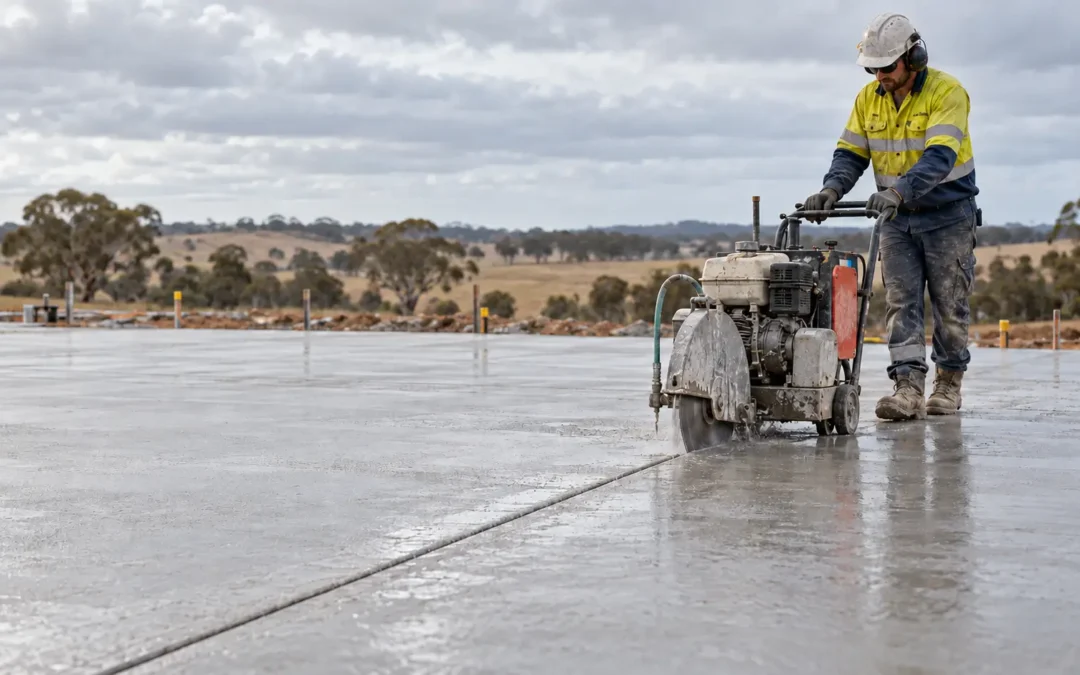
Walk through a warehouse, workshop or modern driveway and you will often see straight saw cuts running across the concrete. They may look simple, but the timing, placement and way those cuts are made can affect how the slab performs for years.
Concrete shrinks as it cures and responds to temperature, moisture and other conditions over its life. Planned joints encourage cracking to occur along selected lines instead of leaving the slab to crack wherever it finds a weak point.
This guide explains what the cuts do, when they are made and why planning the work properly matters to the slab, the people working on site and those nearby.
What Is Expansion Joint Cutting?
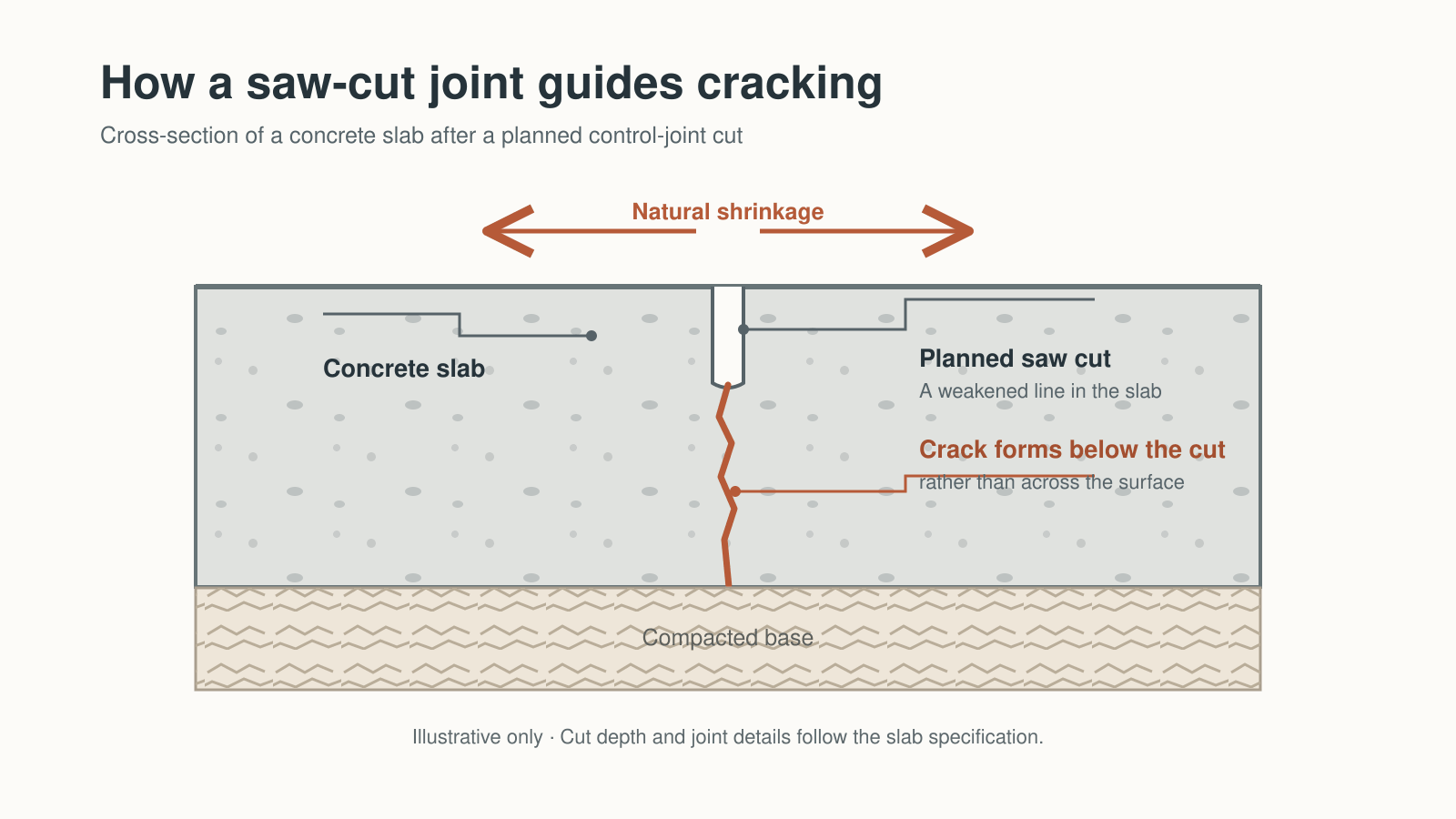
Expansion joint cutting is a form of floor and slab cutting that creates planned lines in concrete to help manage movement and cracking. A saw cuts partway into the slab, creating a weakened line beneath where any cracks are more likely to form as the concrete shrinks.
Why Are Those Lines Cut Into Concrete?
Concrete is strong, but it does not stay perfectly still. As a new slab cures, it shrinks. Temperature changes, moisture, loading and movement beneath it can add further stresses.
A planned saw cut gives a developing crack a preferred path. That can protect the appearance and serviceability of a driveway, workshop or industrial floor. The goal is to influence where cracking happens, not to promise that concrete will never crack elsewhere.
We’ve seen other factors affect a slab despite planned joints, including the concrete mix, ground conditions, groundwater, compaction, nearby vibration and temperature changes. Joint cutting is an important part of the plan, but it cannot correct every issue in the concrete or beneath it.
How Does Expansion Joint Cutting Work?
The basic sequence is straightforward:
- The slab is poured and finished.
- The joint layout and required cut details are confirmed against the project plan.
- The cutter assesses when the concrete is firm enough to cut cleanly, while still within the useful cutting window.
- The planned lines are marked and cut with equipment suited to the slab and site.
- As the concrete shrinks, cracking is encouraged to form beneath those cuts.
The difficult part is judging the conditions in front of the saw. Cutting too early can tear or chip the edges, leaving rough lines in a finished slab. Cutting too late can mean a crack has already formed somewhere else.
We’ve encountered both outcomes on site. There’s no single visible sign that tells every builder the slab is ready; that’s why a professional concrete cutter is required to assess the particular mix and slab at the time.
When Should Expansion Joints Be Cut?
There is no single number of hours that suits every pour. The mix, additives, weather, finish and way the slab is curing can change when it is ready. It’s a balance: early enough to guide cracking, but late enough to leave a clean cut.
On some South West jobs, a crew pours in the morning, finishes the slab and arranges for joint cutting that afternoon. Rain may arrive the next day, particularly in the wetter months, just when the slab needs attention. Wet weather can change site conditions and complicate the planned cutting method; waiting for a convenient dry day may mean missing the useful cutting window and potentially delaying the build timeline, which no one wants.
This is why the cutter, concreter and builder should coordinate around the pour, with a workable plan for the forecast.
The question we hear most often from customers is, “When can you be here?”
In the South West’s wetter months, that is particularly pressing: the slab’s readiness, the weather and the availability of the cutter all need to line up. Getting a cutter involved before the pour helps protect the cutting window and keeps following trades moving.
How Deep Do the Cuts Need to Be?
A cut needs enough depth to encourage the slab to crack along the intended line. The depth should be one-third of the slab thickness as a general guide. For example, that would be about 33 mm in a 100 mm slab. It is a guide for these saw-cut control joints, not an instruction to use the same depth on every project.
The engineer’s or concreter’s specified joint detail takes precedence, and the required depth can depend on the slab and how the joint is designed. A cut that is too shallow may fail to guide cracking; the cutter should confirm the required depth before starting rather than guessing from the slab’s appearance.
Where Will You See These Joints?
Planned joints appear in residential driveways, workshops, machinery sheds, commercial floors, warehouses and other concrete slabs. A driveway may need only a small number of cuts; a large industrial floor can involve long runs and a more complex layout. In each case, the cuts must suit the slab and what it will be used for.
What Happens If the Timing or Planning Is Wrong?
An early cut can leave chipped, uneven edges. A late cut may arrive after the slab has cracked. Poorly considered joint placement may leave the concrete to crack somewhere other than the intended line.
It is also possible for a slab to crack for reasons beyond the saw cuts. We’ve been called in when movement contributed to cracking to make a release cut, and it’s a headache you want to avoid adding to your build timeline.
It’s a useful reminder that joints, reinforcement, the slab and the ground all interact.
How We Control Dust and Slurry During Joint Cutting
Getting the joint line right is only part of doing the job properly. Dry cutting can produce concrete dust that affects the operator, other trades, people who enter the site afterwards, and residents or neighbours nearby. Dust control has to work for the actual length and location of the cut, including wind and available power.
South West Concrete Cutting & Drilling prefers water-fed saws and wet cutting for this work because silica dust is a serious health risk, not just a mess to clean up. Cutting concrete can release respirable crystalline silica: particles so fine they may be invisible and remain in the air. Breathing them can cause silicosis, an irreversible lung disease, and other serious illness. Dust can affect our crew, other trades, residents and neighbours, and can settle on surfaces to be disturbed later. Water at the blade suppresses much of the dust before it becomes airborne. Wet cutting still needs effective controls and slurry cleanup, but we carefully plan for those from the outset rather than leaving dust to spread across the site causing damage, health risks and a much bigger cleanup.
A dry-cut saw can be used with suitable extraction, but on a long run the vacuum hose, power supply and trailing leads can be difficult to manage effectively. It is not enough to choose a dry-cut saw and assume the dust will take care of itself.
Wet cutting still needs a plan. The water carries concrete particles away as slurry, which must be contained and dealt with so it does not create a problem for the next trade or the people using the area afterwards. We’ve seen first hand how an inadequate slurry plan can affect a site after the sawing is done.
The method therefore needs to be chosen before work starts. Where will the dust go? Where will the slurry go? Who else is working nearby, and who needs to use the space next? A quick attempt with whatever saw is at hand can turn a simple-looking task into a huge cleanup, delayed finish or scheduling disaster in the greater build.
Why Bring in a Professional Cutter First?
If you are a builder or concreter considering making the cuts yourself, speak to us before the pour.
The saw cut is permanent. A cut made at the wrong time can chip the finished edges or arrive after uncontrolled cracking has begun; a cut in the wrong place or at the wrong depth may not guide cracking as intended. You also need a workable plan for the dust or slurry the equipment produces. Calling after the first attempt cannot put that time or the original surface back.
We can help plan when and how the work should happen and will carefully assess the condition of the concrete, the specified joint layout and depth, site access, cutting equipment, forecast, other environmental factors and the potential impacts effect on everyone and everything around the work.
Having those decisions made before the first cut can avoid damaged joint edges, uncontrolled dust or slurry, rework and delays to other trades.
Frequently Asked Questions
Will joint cutting stop all cracks?
No. Planned saw cuts encourage cracking beneath selected lines, but the concrete mix, ground, loading and environmental conditions can still affect a slab.
Can the joints be cut the day after a pour?
Sometimes, but it depends on how the particular slab is curing. On other jobs, the useful window may arrive sooner. In the wetter months, rain on the following day can complicate access and the chosen cutting method. Ideally, arrange the cutter around the pour and forecast is favourable rather than relying on a fixed next-day booking, however, we are available on emergency request.
Is dry cutting better for expansion joint cutting?
Dry cutting avoids water and slurry, but it requires effective dust extraction suited to the run and site. We prefer water-fed saw cuts because suppressing dust at the blade helps protect workers and prevents it from blowing onto surrounding areas. Wet cutting still requires a plan to contain and remove slurry, and so we always ensure our chosen approach suits the slab and site conditions.
Professional Joint Cutting Across the South West
South West Concrete Cutting & Drilling works with builders, concreters and property owners across Bunbury, Busselton, Margaret River and the wider South West. If you are planning a driveway, workshop, warehouse or commercial slab, call us before the pour or before making the first cut to ensure a clean job keeping your build schedule on track. Share the slab plan, pour date and expected site conditions so the joint details, cutting window and dust or slurry controls can be planned together.
Learn more about our Floor & Slab Cutting service or get in touch to discuss the pour and the cuts it needs.